WhatsApp investment group rules and moderation
A guide for admins of financial education groups, investment clubs and market communities who want to operate within securities rules.
How it works in practice

Step by step in the 9bot dashboard
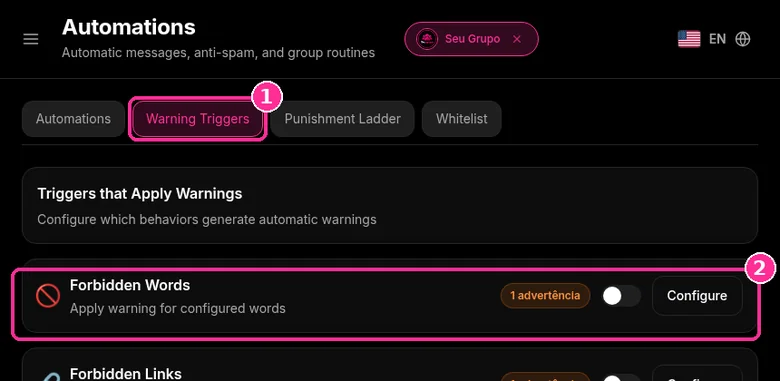
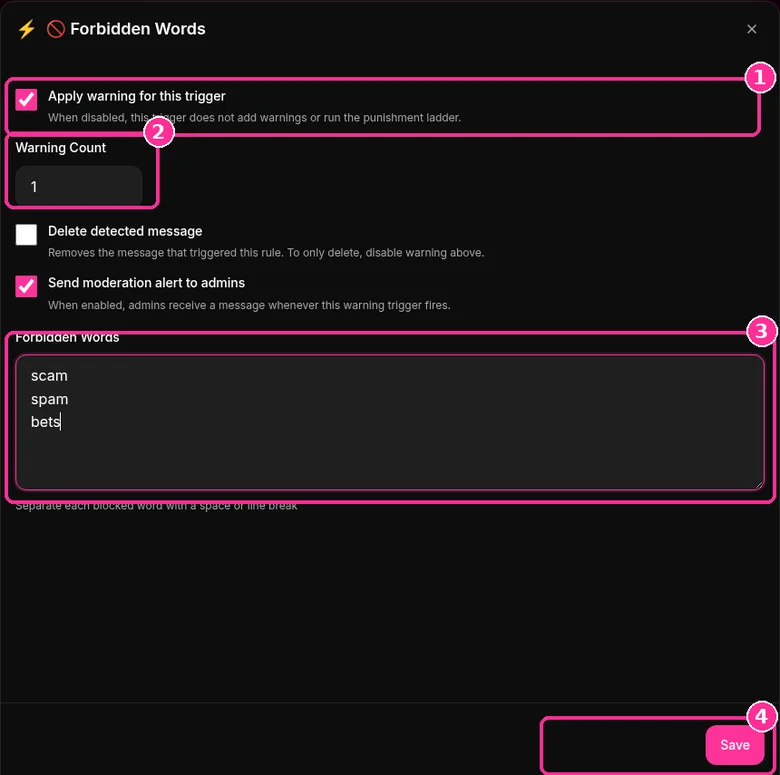
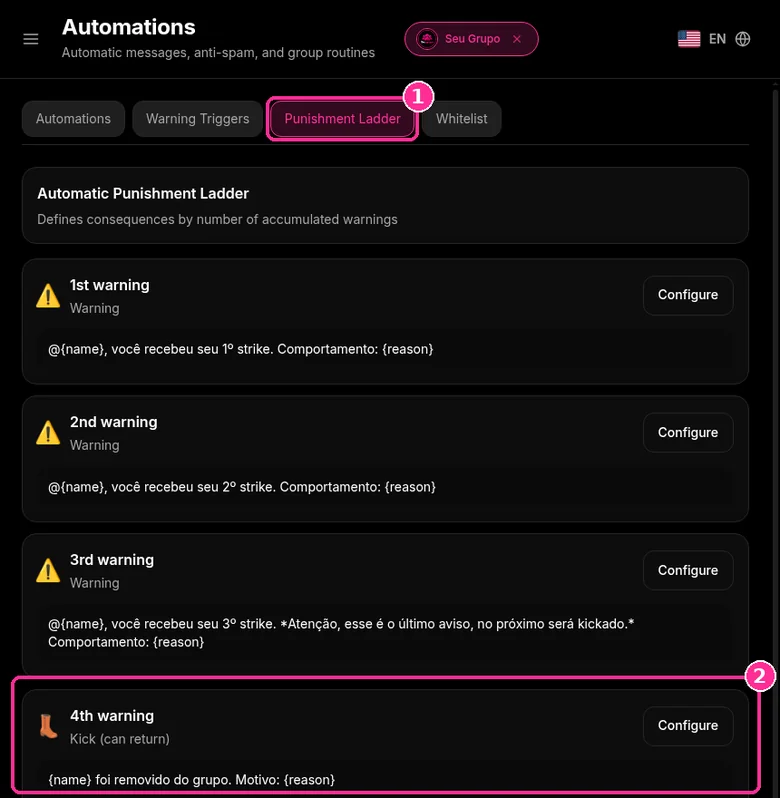
In the side menu, open Automations. The Warning Triggers, Punishment Ladder and Whitelist tabs control when 9bot warns and what happens next. The screenshots below come from the real dashboard, in a test group called "Seu Grupo", with member names and contacts blurred. The numbers on the images follow the order of the clicks.
In investment groups, add promise terms such as guaranteed return to Forbidden Words so every hit counts toward the ladder.
Step 1: Pick the trigger
- Open the Warning Triggers tab ("Triggers that Apply Warnings").
- Find the trigger, for example Forbidden Words or Forbidden Links, and click Configure.
Step 2: Set up the trigger
- Tick Apply warning for this trigger.
- In Warning Count, set how many warnings each hit adds.
- If you want, tick Delete detected message and Send moderation alert to admins.
- Write one word per line in the word field and click Save.
Step 3: Review the Punishment Ladder
- Open the Punishment Ladder tab.
- By default, the 1st, 2nd and 3rd warnings send a notice and the 4th warning applies Kick (remove from group, can return).
Step 4: Adjust a step
- Click Configure on the step you want to change.
- Choose the Punishment Type and edit the message. The {name} and {reason} variables go into the text.
- Click Save.
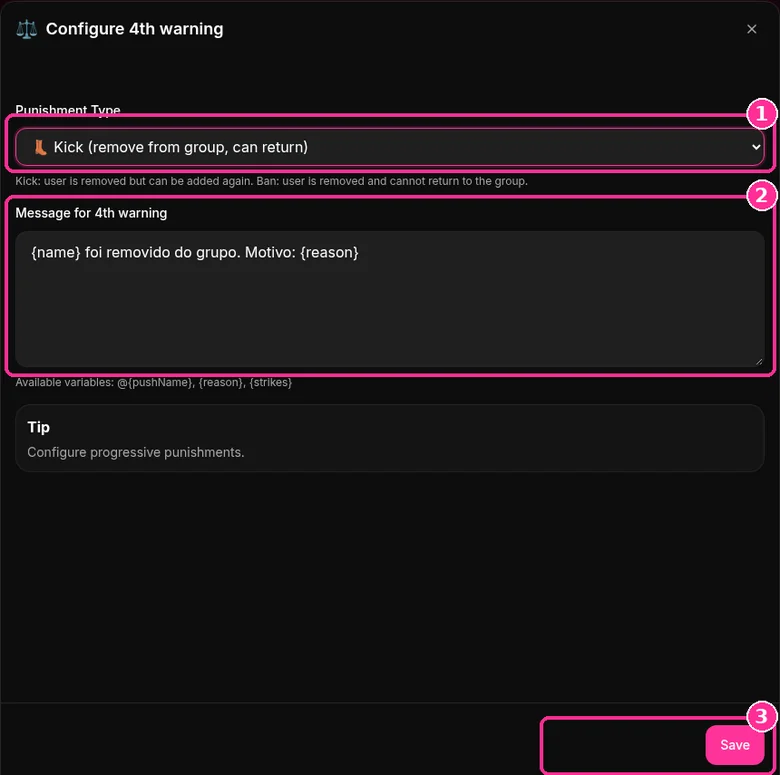
Step 5: Exempt who needs it
- On the Whitelist tab, click Add first user to free someone from automatic warnings.
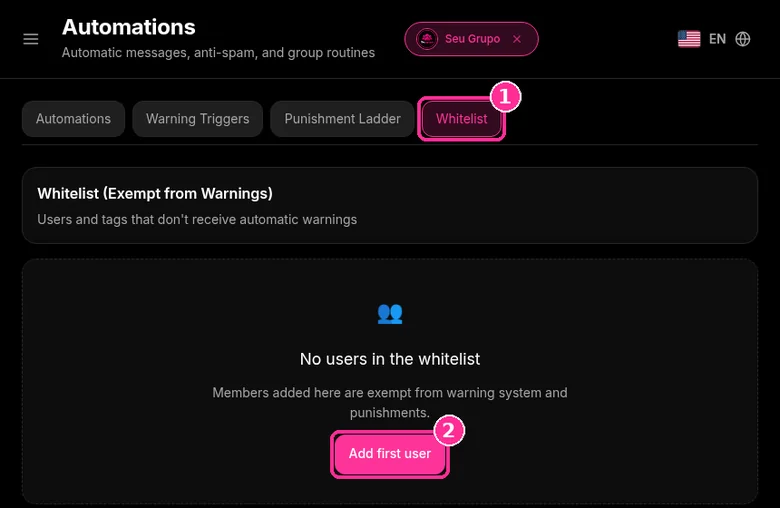
Want to try it in your group? See the 9bot plans with a 7-day trial.
Direct answer: Recommending specific investments professionally, habitually or for pay is a regulated activity in many countries. In Brazil it is the work of a securities analyst under CVM Resolution 20 and requires accreditation. A WhatsApp group that distributes buy and sell "calls" may fall under this activity even with a "not a recommendation" disclaimer. Educational content that does not point to a specific asset to buy or sell is not analysis. In other countries, check your local securities regulator.
In short:
- Professional, habitual or paid recommendations need accreditation in Brazil (CVM Resolution 20).
- A disclaimer does not turn a recommendation into education.
- Pyramid schemes and fake managers are the main risk for members.
Brazil's CVM Resolution 20: who may recommend
CVM Resolution 20/2021 regulates securities analysts: preparing reports or recommendations on specific securities professionally. The CVM has warned that influencers who recommend assets habitually or for pay may need accreditation.
Phrases such as "not a recommendation" do not avoid the rule if the content, in practice, tells people what to buy or sell.
Educational content versus recommendation
| Content | Status |
|---|---|
| Explaining fixed income, stocks or funds | Educational |
| Teaching how to read a balance sheet with a historical example | Educational |
| Saying "buy asset X today" | Specific recommendation |
| A suggested portfolio with target prices | Specific recommendation |
| Paid buy and sell signals | Paid recommendation |
Scams that reach investment groups
- Promises of guaranteed or daily returns.
- Fake managers who message members privately.
- "Trading robots" and unregistered platforms.
- Pyramids with referral bonuses.
See also how to handle member spam.
Rules and moderation
- Define the group as educational in the pinned rules.
- Prohibit buy or sell calls on specific assets.
- Restrict links and remove invitations to platforms.
- Tell members never to transfer money to group contacts.
9bot removes links outside the allowlist and answers commands such as .rules and .scams. 7-day trial; with the coupon FIRST9, monthly plans are 50% off for the first 3 months after the trial.
Read also

FAQ
At which warning does 9bot remove a member?
Is a WhatsApp investment group legal?
Does a "not a recommendation" disclaimer protect the admin?
Can I charge for a signals group?
How do I spot a scam in an investment group?
What about outside Brazil?
How do I find a trustworthy investment group?
Do investment groups on Telegram follow the same rules?